This is my first time corresponding with you and the others even though I read all your information and certainly learn a lot from other artists. I would Love to share a painting for which I surprisingly received national attention. A little background first. I am proudly a member of DAR (Daughters of the American Revolution) and work with the arts on a local and state level “Preserving, Protecting, Conserving and Safeguarding our Rich and Diverse Heritage”. One way we attempt to fulfill this vision is to ask our members to submit their artwork for judging on their interpretation of the yearly theme. I submitted a silhouette painting symbolic of a woman who worked as a spy for General Washington. I have included the narrative explaining her role which details how she was able to do this.
My love for art, history and my church cannot be separated. I am so fortunate to be able to express my love of art to my spiritual family with faith based art classes, and to my DAR family by teaching colonial arts and crafts with a contemporary twist.
A final thought. I have a great deal of trouble finishing projects! So many ideas to work on and new method experiment with! And then I looked at the name of your group and realized that I am a “contemplative artist” in the fullest sense. The process is the most important. So thank you for lessening my guilt about unfinished projects!
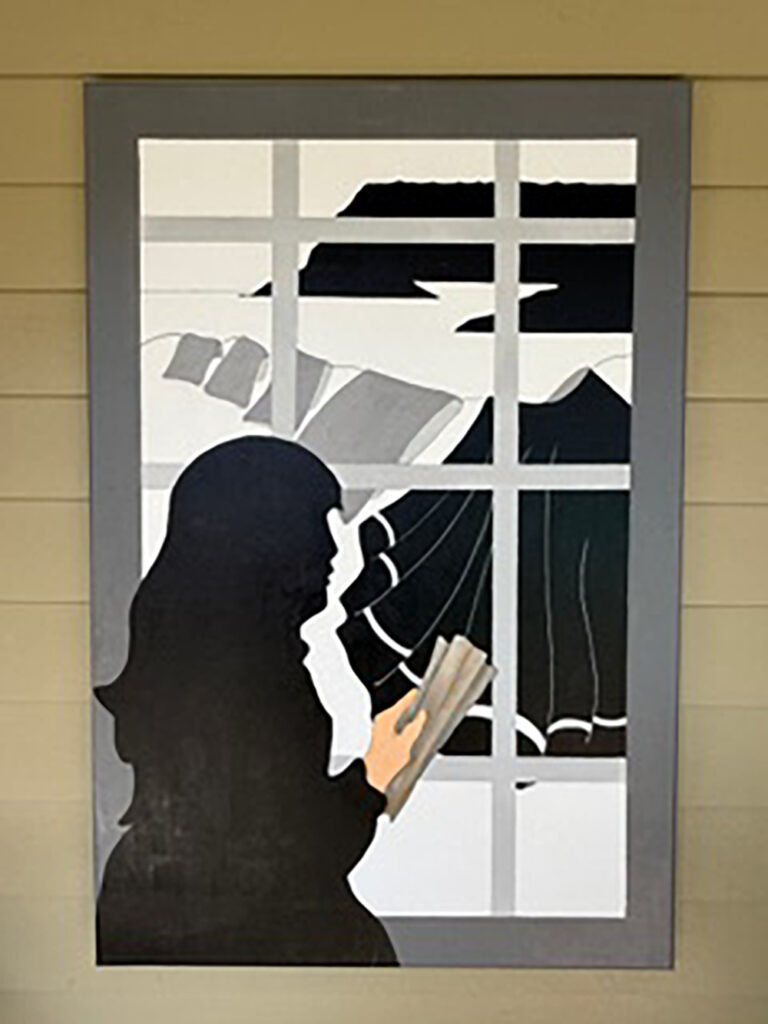
Anna Smith Strong (1740-1812) carried out a brave and subtle act of rebellion instrumental in the war for independence. Living on Strong’s Neck on Long Island, she appeared to be an ordinary woman tending to her home during the British occupation. In reality, she was a trusted member of the secret Culper Spy Ring, the intelligence network organized by Major Benjamin Tallmadge for General George Washington. Her job was to signal fellow spy Abraham Woodhull whenever courier Caleb Brewster arrived by whaleboat from Connecticut. Brewster carried important intelligence that needed to be passed quickly and secretly through the network.
In plain view of the British, she hung her laundry on a clothesline. A black petticoat signaled that Brewster had arrived. Since the shoreline had several small coves where Brewster could hide his boat, Anna added another layer to her code. She hung white handkerchiefs beside the petticoat, with the number of handkerchiefs showing exactly which cove he was hiding in. One handkerchief meant the first cove, two meant the second, and so on. By counting the number of white handkerchiefs on the line, Woodhull knew which cove Brewster was in.
I chose to tell Anna’s story by using silhouettes, an art form very popular during colonial times. Following Anna’s lead, I felt it was important to convey how Anna approached a very complicated situation with a very simple solution. Rather than cut paper, I used oil painting techniques on a 24 x 36 canvas. I simplified my interpretation of this dangerous event by rendering each action to its most basic shape and form, a silhouette. I reduced the tents and buildings of General Washington’s encampment to mere outlines in the distance. Anna’s petticoat and handkerchiefs blow in the wind on a line signaling the location. I placed Anna standing in the safety of her home, a message in her hand symbolizing her act of rebellion. Only her hand and message have color and form, symbolizing the change and hope her actions set in motion.
Each element in this painting reflects Anna’s strong character and will to find ways to use what was on hand to support the fight for independence. There is much more to this story, but for now, let us remember that Anna, by simply doing her laundry, saved lives, helped win the war, and best of all, never got caught!